
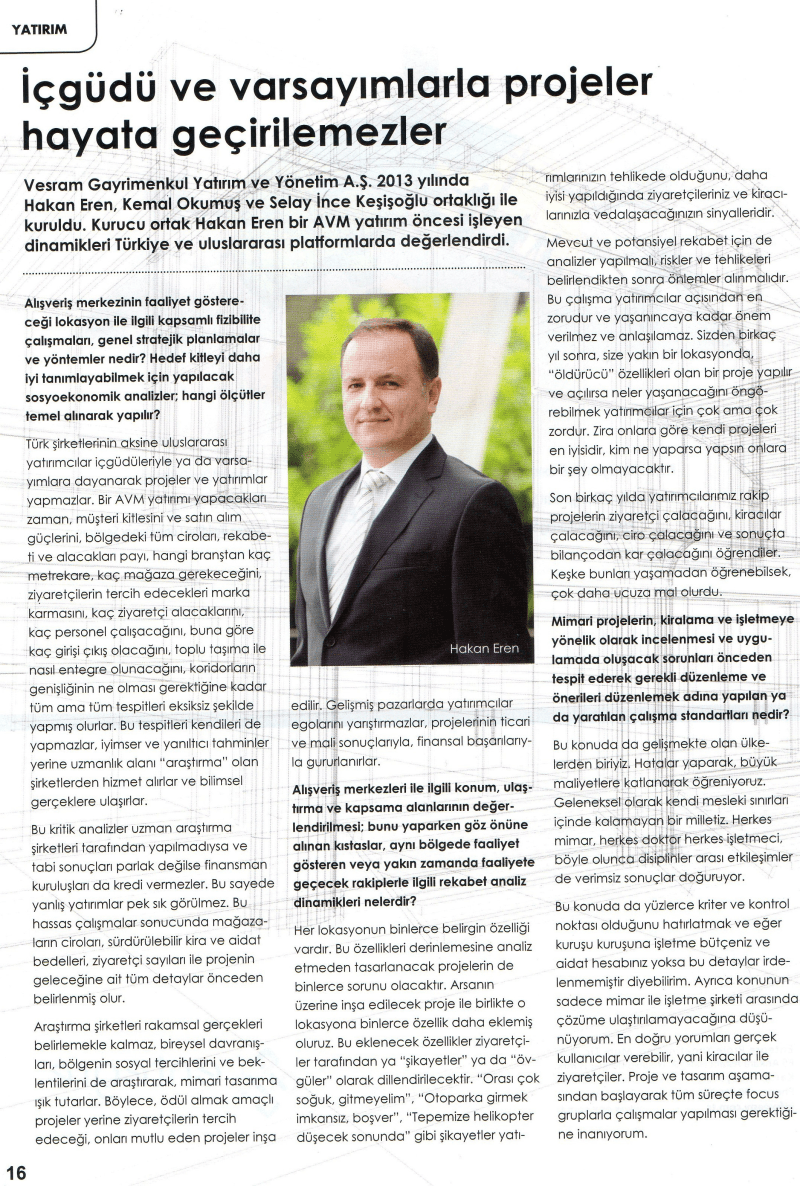
Vesram Real Estate Investment and Management Inc. was founded in 2013 as a partnership between Hakan Eren, Kemal Okumuş, and Selay İnce Keşişoğlu.
Founding partner Hakan Eren assessed the dynamics of a shopping mall’s operations prior to investment, both in Turkey and on the international stage.
What are the comprehensive feasibility studies, general strategic planning, and methodologies related to the location where the shopping center will operate? What socio-economic analyses will be conducted to better define the target audience, and what criteria will they be based on?
Unlike Turkish companies, international investors do not undertake projects or investments based on intuition or assumptions. When planning a shopping mall investment, they thoroughly assess the customer base and purchasing power, total sales volume in the region, competition and their expected market share, the number of square meters and stores required by each retail sector, the brand mix preferred by visitors, the expected number of visitors, the number of staff to be employed, the number of entrances and exits required based on these factors, how the mall will integrate with public transportation, and even the optimal width of the corridors—they conduct a comprehensive analysis of every single detail. They do not perform these analyses themselves; instead of relying on optimistic or misleading estimates, they engage companies whose area of expertise is “research” to obtain scientific facts.
If these critical analyses are not conducted by specialized research firms—and, of course, if the results are not promising—lending institutions will not grant loans. As a result, misguided investments are rarely seen. Thanks to this meticulous work, all details regarding the stores’ revenue, sustainable rent and maintenance fees, visitor numbers, and the project’s future are determined in advance.
Research firms do more than just determine numerical facts; by investigating individual behaviors, the region’s social preferences, and expectations, they shed light on architectural design. Thus, instead of projects aimed at winning awards, projects that visitors will prefer and that make them happy are built. In developed markets, investors do not compete based on ego; they take pride in the commercial and financial outcomes of their projects and their financial success.
What are the criteria considered when evaluating the location, transportation, and catchment areas of shopping centers, and what are the dynamics of competitive analysis regarding rivals operating in the same region or set to open soon?
Every location has thousands of distinct characteristics. Projects designed without a thorough analysis of these characteristics will inevitably face thousands of problems. By building a project on a plot of land, we add thousands more characteristics to that location. These added characteristics will be voiced by visitors as either “complaints” or “praise.” Complaints such as “It’s too cold there, let’s not go,” “It’s impossible to get into the parking lot, forget it,” or “A helicopter is going to crash on our heads eventually” are signals that your investments are at risk and that you’ll have to say goodbye to your visitors and tenants once a better alternative is built.
Analyses must also be conducted regarding current and potential competition; once risks and threats are identified, precautions must be taken. This is the most challenging aspect for investors—it’s often overlooked and misunderstood until it actually happens. It’s extremely difficult for investors to foresee what will happen if, a few years after you’ve launched your project, a “game-changing” project with “killer” features is built and opens in a nearby location. After all, in their view, their own project is the best, and no matter what others do, nothing will happen to them.
Over the past few years, our investors have learned that competing projects will steal visitors, tenants, revenue, and ultimately, profits from their balance sheets. If only we could have learned these lessons without going through them—it would have been much less costly.
What are the established or developed work standards for reviewing architectural projects in terms of leasing and operations, and for identifying potential problems in practice in advance to formulate the necessary adjustments and recommendations?
We are also one of the developing countries in this regard. We are learning by making mistakes and incurring significant costs. Traditionally, we are a nation that cannot stay within the boundaries of our own professions. Everyone is an architect, everyone is a doctor, everyone is a businessperson—and when this happens, interdisciplinary interactions lead to inefficient results.
I’d like to remind you that there are hundreds of criteria and checkpoints in this regard, and if your operating budget and maintenance fee account aren’t down to the last penny, I can say these details haven’t been thoroughly examined. Furthermore, I believe this issue cannot be resolved solely between the architect and the management company. The most accurate feedback comes from actual users—that is, tenants and visitors. I believe that focus groups should be utilized throughout the entire process, starting from the project and design phases.