
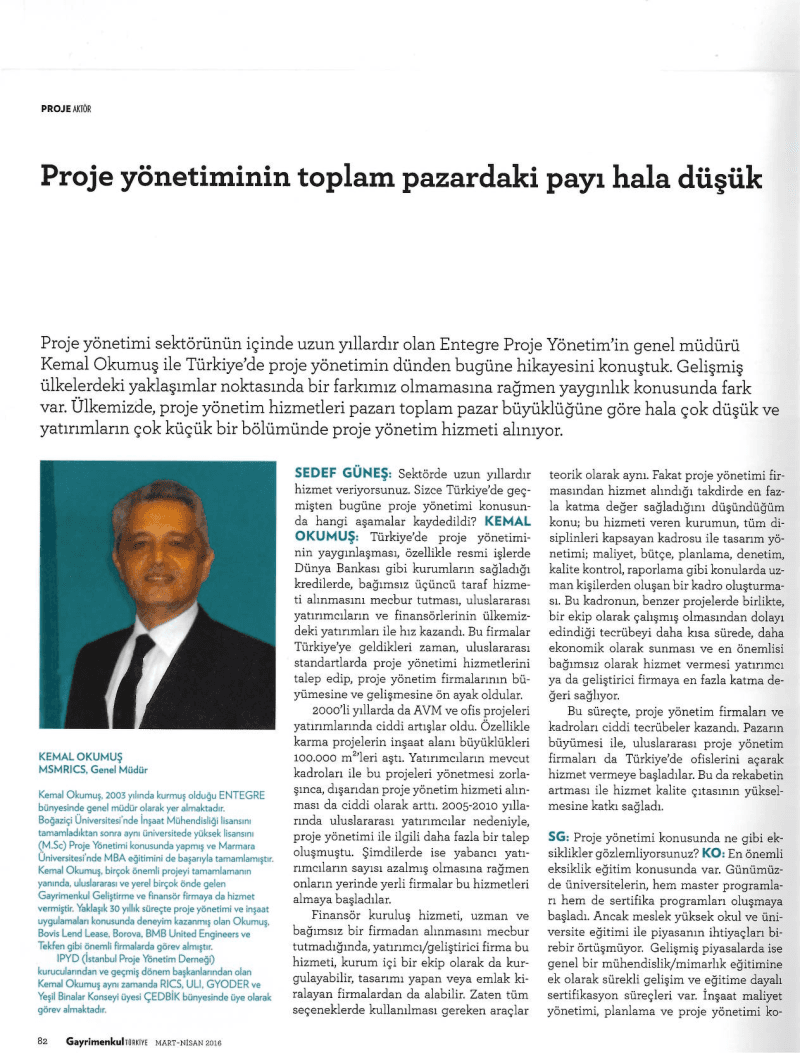
PROJECT MANAGEMENT’S SHARE OF THE OVERALL MARKET REMAINS LOW
We spoke with Kemal Okumuş, General Manager of Entegre Proje Yönetim—a company that has been in the project management sector for many years—about the history of project management in Turkey from its beginnings to the present. Although there is no difference in our approach compared to that in developed countries, there is a difference in terms of prevalence. In our country, the project management services market is still very small relative to the total market size, and project management services are utilized in only a very small portion of investments.
You have been providing services in the sector for many years. In your opinion, what milestones have been achieved in project management in Turkey from the past to the present?
The spread of project management in Turkey gained momentum, particularly in public sector projects, due to the requirement by institutions such as the World Bank—when providing loans—to engage independent third-party service providers, as well as through investments by international investors and financiers in our country. When these firms entered the Turkish market, they demanded project management services that met international standards, thereby paving the way for the growth and development of project management firms.
The 2000s also saw significant increases in investments in shopping mall and office projects. In particular, the construction areas of mixed-use projects exceeded 100,000 ma. As it became increasingly difficult for investors to manage these projects with their existing staff, the outsourcing of project management services also rose significantly. Between 2005 and 2010, demand for project management services grew substantially due to international investors. Although the number of foreign investors has since declined, domestic firms have now begun to utilize these services in their place.
When the financing institution does not require the service to be provided by a specialized and independent firm, the investor/developer firm can either set up an in-house team to provide this service or obtain it from firms that handle design or property leasing. Theoretically, the tools required are the same across all options. However, when services are obtained from a project management firm, the area where I believe the greatest added value is provided is the firm’s ability to assemble a team of experts—covering all disciplines—for design management, as well as specialists in areas such as cost, budget, planning, supervision, quality control, and reporting. The fact that this team can deliver the experience gained from working together on similar projects more quickly and cost-effectively—and, most importantly, provide services independently—offers the greatest added value to the investor or developer firm.
During this process, project management firms and their staff have gained significant experience. As the market has grown, international project management firms have also begun offering services by opening offices in Turkey. This, in turn, has contributed to raising the bar for service quality as competition has intensified.
What shortcomings do you observe in the field of project management?
The most significant shortcoming lies in education. Today, universities have begun offering both master’s programs and certificate programs. However, the education provided by vocational schools and universities does not fully align with the market’s needs. In developed markets, in addition to a general engineering or architecture education, there are certification processes based on continuous development and training.
You specialize in construction cost management, planning, and project management, earn a certification, and strive to continuously improve yourself to maintain that certification. The core of project management lies in institutionalizing the experience gained by both the individual and the firm, disseminating the lessons learned throughout the organization, and ensuring that the same mistakes are not repeated—or that the next project is completed in a shorter timeframe or with higher quality. If you look at what foreign firms are doing in this regard, there are companies with workforces ranging from 50,000 to 100,000. Check out their websites; they all have programs—under the name “Graduate Program”—designed to train their staff according to their own systems.
Second, there is no legal framework for this field in Turkey. It is unclear what the scope of responsibility for this service is or how it should be defined. In international practice, PI (Professional Indemnity), or professional liability insurance, is a very important and widespread consideration. Institutional investors evaluate this service from a risk transfer perspective and award contracts—based on performance—to firms that have gained experience in this field or have completed similar projects at least several times.
Finally, in our country, “price” is generally not considered the most important criterion when selecting a project management firm. This hinders the development of personnel and service quality. Of course, working efficiently with an optimal staff and budget is important, but when selecting a firm, factors such as staff, experience, and performance must also be taken into account for the sector’s development.
“We are making efforts both to develop and grow the market and to define roles and responsibilities.”
What other differences do you observe between the global and Turkish approaches to project management?
Fundamentally, there is no difference; the differences lie only in terms of prevalence. In our country, the project management services market is still very small relative to the total market size, and project management services are utilized for only a very small portion of investments.
Another issue concerns service performance and accountability. Globally, the logic of project management has not changed over time, but in the past, it was mostly based on risk-free monthly fees. In other words, a team is formed, and that team’s monthly fees are paid at a fixed rate throughout the service period. Extensions in duration or increases in cost did not significantly affect this. Today, services have increasingly shifted toward lump-sum and performance-based arrangements. In Turkey, due to government projects and legal requirements, this approach has come to be widely used in real estate investment companies’ (GYO) investments.
We are making efforts both to develop and grow the market and to define roles and responsibilities. This depends on our ability to successfully complete projects within the optimal timeframe, budget, and in line with the client’s expectations. Generally, in the international market, the roles and responsibilities of stakeholders are defined before work begins. It has become increasingly common for the investor or developer firm to specify the services, tasks, and responsibilities they expect through a project-specific “Request for Proposal (RFP).” Our expectation is that all tenders will be organized within this framework.
Another area in our country that requires further development is the very limited use of “Quantity Surveying—Quantity and Cost Consulting” firms, which prepare project measurements and specifications independently and within the framework of their responsibilities under the supervision of design firms and/or review and audit them on behalf of the client. International investors set targets for design firms not only regarding project efficiency but also concerning the total investment budget. In developed countries, this service has been systematized, and specialized firms capable of assuming responsibility in this area have been established. In our country, however, there is uncertainty, though specialized firms are gradually emerging.
Is there an organization in Turkey that addresses the shortcomings you mentioned and spearheads developments in this area?
It exists in name and in terms of activities, but both the construction and project management sectors provide little support to this organization. We were involved in the founding of the IPYD—the Istanbul Project Management Association—in 1996. This association works to develop and promote the PMI (Project Management Institute) methodology, which is widely used around the world. In this regard, companies in the banking, IT, and telecommunications sectors took the lead, supporting the development of training and applications; however, the construction sector lagged behind. There is also the UPYE (International Project Management Institute Association), which works in this field. Both associations are making significant efforts to advance the sector. Additionally, there are associations in Istanbul and Ankara—also affiliated with PMI—founded by PMP-certified professionals, though these primarily operate in other sectors. We, too, strive to participate and provide support within the scope of our capabilities. I believe that the widespread adoption of these associations, their support by all stakeholders, and the establishment and expansion of local certification and training systems will make a significant contribution to the development of project management.
Real Estate Turkey MARCH–APRIL 2016