

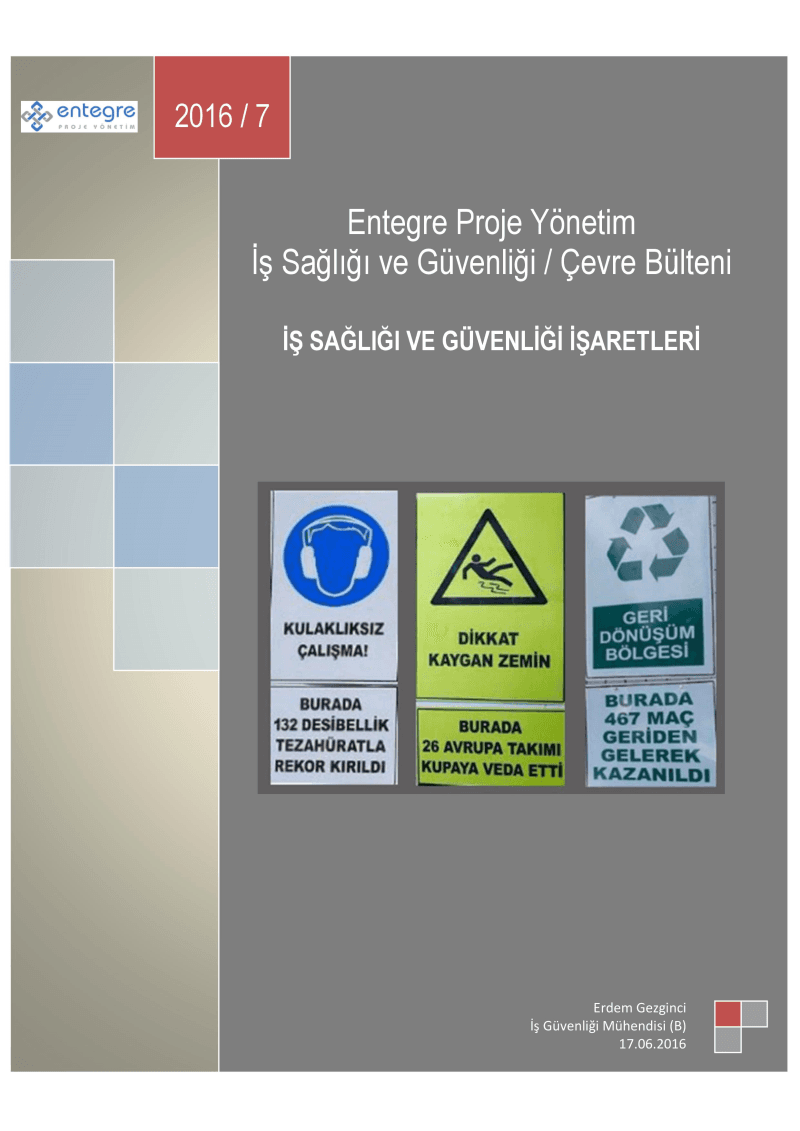
To increase Occupational Health and Safety / Environmental awareness and to contribute to raising awareness on certain topics beyond training sessions, we have prepared the seventh issue of our OHS-E Bulletin:
“OCCUPATIONAL HEALTH AND SAFETY SIGNS”
The Importance of Occupational Health and Safety Signs
Health and safety signs are used in cases where workplace risks cannot be eliminated or cannot be sufficiently reduced through collective protection techniques or through measures, methods, or processes used in the organization of work. Especially on construction sites, occupational health and safety signs are very important in terms of making the presence of occupational safety felt, creating an occupational safety culture, keeping occupational safety awareness active, and ensuring that vital warnings are given continuously. Occupational safety signs that appeal to visual memory continuously remind workers of instructions, prohibitions, obligations, and warnings in highly hazardous works and help ensure that they are adopted.
Definitions of Occupational Health and Safety Signs
| Color | Meaning or Purpose | Instruction and Information |
|---|---|---|
| Red | Prohibition sign | Dangerous action or behavior |
| Red | Danger alarm | Stop, shut down, emergency stop device, evacuate |
| Yellow | Warning sign | Be careful, take precautions, check |
| Blue (1) | Mandatory sign | Specific behavior or action, use personal protective equipment |
| Green | Emergency exit, first aid sign | Doors, exits and routes, equipment, facilities |
| Green | No danger | Return to normal |
Blue (1):
It is considered a safety color only when used in a circular shape.
Bright orange (2):
It may be used instead of yellow outside safety signs. This fluorescent color is especially noticeable in poor natural visibility conditions.
- Prohibition Signs
- Warning Signs
- Mandatory Signs
- Emergency Exit and First Aid Signs
- Fire-Fighting Signs
Points to Consider When Using Occupational Health and Safety Signs
- Signs should be as simple as possible.
- Signboards must be made of materials suitable for the environment in which they are used and resistant to impact and weather conditions.
- The dimensions, colorimetric, and photometric properties of signboards must ensure that they can be easily seen and understood.
- Signboards must be placed close to areas with specific hazards and dangerous objects, and at the entrances of areas with general hazards. Taking obstacles into account, they must be positioned at an appropriate height and location suitable for the line of sight, well-lit, easily accessible, and visible.
- When the situation indicated by the signboard no longer exists, the signboard must also be removed.
- The lifting, lowering, or transportation of loads by lifting machines is carried out according to hand and arm signals given by trained signalers.
- In cases where more than one employee is assigned to a lifting machine, the lifting machine operator must receive signals from only one person among the signaler or other assigned personnel, and the signaler must stand in a place where they can be easily seen by the operator. The operator must always comply with every stop signal, regardless of who gives it.
- If repairs are being carried out on vehicles, warning signs indicating that repair work is being performed must be placed on the vehicles and in appropriate locations.
- The maximum loads that lifting equipment can lift must be indicated as information signs inside or outside the cabins. When a load heavier than the maximum allowable load is lifted, an automatic audible and visual warning device must be available to indicate the situation.
- The bell sounds and light signals used on lifting equipment must be different from other signal sounds and light signals in the workplace, strong enough to overcome the noise generated by other machines, easily distinguishable, and the same for all lifting equipment operating in the same workplace.
Conclusion
The presence of occupational health and safety signs in working environments is a starting point for creating an occupational safety culture. Especially on construction sites, the use of occupational safety signs should be greater than in any ordinary workplace. Because in the intensity and circulation of work, there may not always be someone to warn us, and we can support occupational safety communication with creative signs that comply with standards.
EPY / HSE REPORT 007: “OCCUPATIONAL HEALTH AND SAFETY SIGNS”