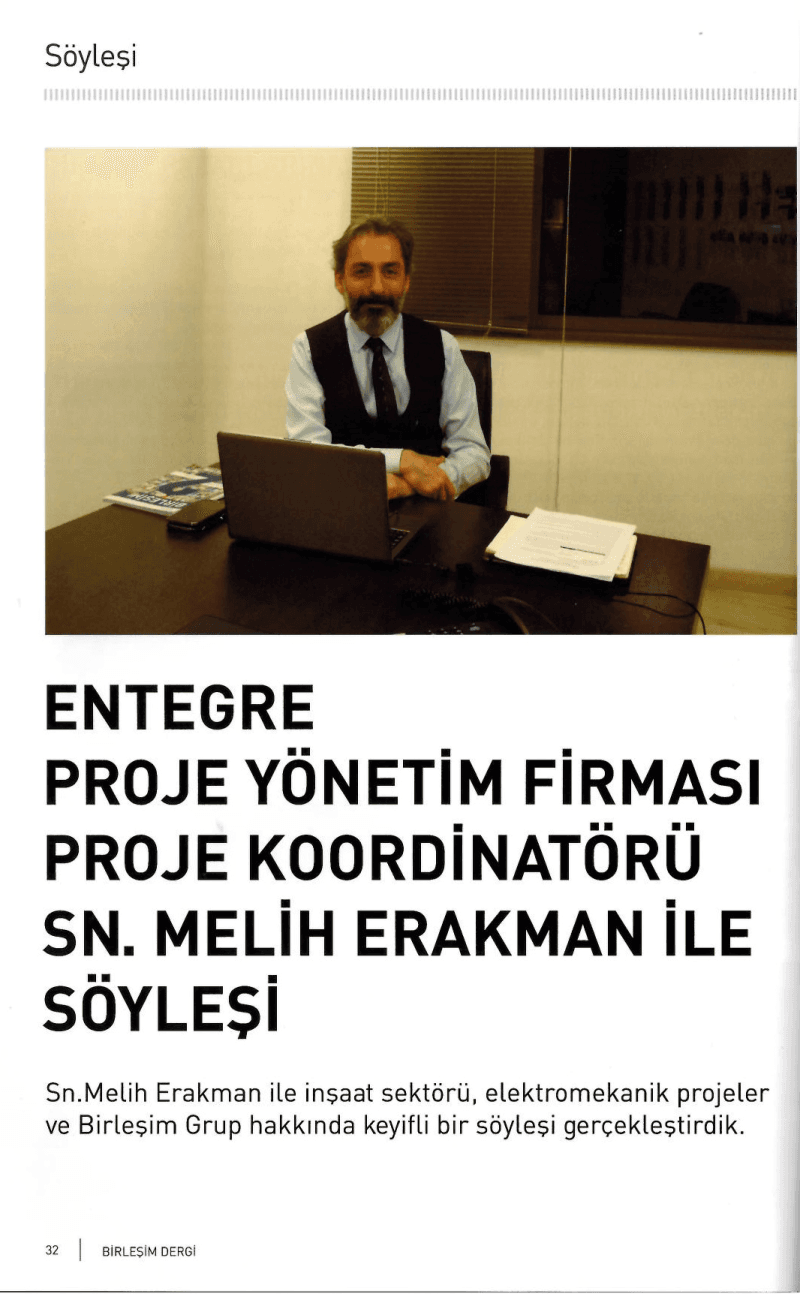
INTERVIEW WITH MR. MELİH ERAKMAN, PROJECT COORDINATOR AT ENTEGRE PROJECT MANAGEMENT
Could you tell us about your company?
ENTEGRE Project Management was founded in 2003 by Kemal Okumuş. The firm provides consulting services—including project/construction management, design management, cost management, technical evaluation, and loan monitoring—to investors, developers, and financial institutions. Its team consists of expert engineers and architects with many years of experience in the industry.
Over the past 14 years, ENTEGRE has successfully completed major shopping malls, residential, hotel, office, and industrial projects in our country. The total number of projects is 140, with a combined construction area of 5,000,000 m². Currently, ENTEGRE’s staff consists of 116 expert engineers and architects.
The construction and real estate sector has played a significant role in Turkey’s economy in recent years. What kind of development do you think awaits Turkey in 2016?
The construction and real estate sector is directly linked to investment decisions—both past and future—as well as the volatility of domestic and international dynamics. In 2016, ensuring a steady flow of capital, establishing the necessary infrastructure to facilitate investments at the desired level both domestically and abroad, and effectively managing these processes will determine the sector’s outlook in terms of project commitments.
What kind of future do you think awaits the construction sector over the next 10 years?
In light of current developments, I foresee that the sector will not experience a significant contraction, provided there are improvements in financing and cash flow.
It is a fact that over the past 10 years, the construction sector has been based on a residential-shopping mall model in major cities and primarily on a shopping mall model in smaller cities. I believe that, in the coming period, in contrast to this trend, mixed-use projects will emerge across all provinces, leading to a shift toward large-scale (min. 300–400,000 m²) investments, and that investment scales will continue in this manner.
Since the sector is primarily based on residential development, there will be no issues as long as supply-demand balances permit it; however, it is an inescapable reality that domestic and international political imbalances leading to small- and large-scale crises will cause unforeseen contractions and standstills due to serious real-world crises. Although it is difficult to predict exactly when this will happen, the possibility of it occurring at any moment exists.
Furthermore, companies that previously operated exclusively in the housing sector in metropolitan areas have begun migrating to Anatolia and have already started doing business in their target cities. This represents a new expansion across Turkey, and we can see that the sector’s operations will not come to a halt over the next 10 years and will continue this process in line with supply-demand balances.
Nationwide, it is essential to encourage and develop industrial investments, renewable energy investments, and other infrastructure projects, and to ensure that this process is well-managed so that the right investments are implemented.
When evaluating a company with a broad scope of services and extensive experience, what are the advantages of having a single firm undertake electromechanical installation work?
Due to the increase in the square meters of electrical and mechanical work compared to previous years, there is now a demand—particularly in industrial and other investment sectors outside of residential construction—for this process to be managed as a single, integrated entity under the electromechanical concept.
Given the interdependent nature of projects—both in terms of operational workflow and electrical and mechanical aspects—managing them under a single entity ensures that responsibility is tracked through a single firm, which provides a significant advantage, particularly during the implementation phase. During the bidding phase, awarding the project to a single firm rather than putting separate contracts out to bid has definitely provided a cost-saving advantage, as has been observed in past tenders. During the management phase, dealing with a single operational structure on-site, along with the interrelated process and technical management of electromechanical systems—and having a single team oversee the project in terms of duties and responsibilities—greatly simplifies the employer’s tasks, particularly during testing, commissioning, and automation processes.
Furthermore, the concept and implementation of having this work carried out under a single umbrella—as well as the increasing number of firms with the capacity to perform such work—are spreading “this culture” and triggering and fostering an understanding and perception of “corporate development and growth” among other firms.
Considering the electromechanical services we provide, what do you think are the most distinctive characteristics of Birleşim and ERDE?
Their proactive and task-oriented approach. They demonstrate the same level of seriousness, sincerity, and trust for every job, whether small or large. In my view, these three points reflect an operational approach and mindset that has permeated all levels of the company’s management, right down to the base of the pyramid. What matters is how realistic and accurate the mission and vision goals you’ve set for your company are during the implementation phase. In my view, BİRLEŞİM (BİRLEŞİM + ERDE) is one of the rare companies that effectively manages this process—both as employers and employees—and sustains it. For this reason, Mesut and İdris deserve unqualified praise in this regard.
How do you assess the electromechanical synergy between Birleşim and ERDE?
Although the process is new, the electromechanical projects secured in the market indicate that this synergy exists and will continue to do so.
Although they may appear similar as contracting firms, these two companies—which are based on distinct areas of work and operations—have shown no signs of incompatibility since the moment of their merger.
The fact that the company’s executives managed their relationships with one another in line with the owners’ goals, combined with the quality of both groups’ long-standing corporate cultures, facilitated this process both internally and in their joint projects, thereby ensuring customer satisfaction.
Birleşim Magazine, April 2016, Interview
Interview: Gökçe Aşkın