

Tourism and Investment Magazine / Issue 61
Topic: The Role of LEED-Certified Hotels in Sustainable Tourism
Interview with Nilay CANBAY ÖZTÜRK, Architect, LEED AP, Quality and Sustainability Manager
Could you explain the objectives of LEED certification and other details? Who launched the certification program, and when was it implemented?
Developed by the U.S. Green Building Council (USGBC) and launched in 1998, Leadership in Energy and Environmental Design (LEED®) is a green building rating system that evaluates and certifies green buildings based on performance-based criteria. LEED is a certification used worldwide today and certifies many types of buildings. If the building is newly constructed, the New Construction version of LEED can be used to certify a sustainable hotel building. Additionally, if a hotel operator leases a building and renovates its interior, that operator can use the version of LEED specifically developed for Commercial Interiors. Currently, LEED Version 4 (V4) is in effect, and projects can obtain LEED certification under this version.
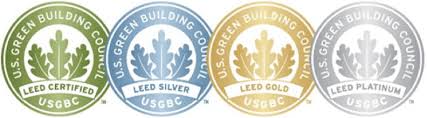
LEED Levels
- CERTIFIED: 40–49 points
- SILVER: 50–59 points
- GOLD: 60–79 points
- PLATINUM: 80+ points
- 110 is the highest possible score in the LEED BD+C (Building Design and Construction) category.
As a firm, what kind of services do you offer regarding LEED certification? How many hotels have you advised on LEED certification to date?
In addition to our core business of Construction Project Management, we provide LEED consulting and project management services—known as Green Project Management—for LEED projects. We provided certification services to the Renaissance Bosphorus Hotel, Turkey’s first 5-star hotel to receive LEED certification. We also provided both consulting and Green Project Management services for the Dedeman Park Levent project, which is under construction in Levent. Similarly, in the hotel projects we’ve recently been involved in, we’ve leveraged our experience with environmentally friendly certifications such as LEED and BREEAM to ensure the design and construction of the projects prioritize environmental sustainability and energy efficiency.
To date, how many hotels in Turkey have qualified for LEED certification? What are the benefits of obtaining this certification for hotels?
It is actually not very common for hotels in Turkey to apply for or obtain LEED certification. LEED’s restrictions on water and energy consumption are not particularly desired by some luxury hotel chains, as there is a misconception that such restrictions will reduce guest satisfaction. Although many foreign-owned hotel chains include these criteria in their design specifications, for some reason they are reluctant to incorporate green building requirements—such as reusing treated graywater in the system or installing waterless urinals—citing hygiene requirements as an excuse. For this reason, LEED stands out in Turkey as a system that is more commonly preferred for corporate office buildings and is easier to implement.
There are approximately 425 projects in Turkey that have obtained LEED certification or have applied for it. About 20 of these projects are hotel projects. Generally, there are no luxury-segment hotel chains among these projects; rather, they consist of city hotels belonging to major hotel chains and standalone hotel investments.
However, the certification offers numerous advantages to hotels. By obtaining this certification, such hotels not only demonstrate that they are environmentally friendly but also prove that they consume less water and energy; furthermore, the certification has a very positive impact on the hotel’s marketing and promotion. Reduced operating costs for the hotel can also be cited as another advantage of LEED-certified hotels.
What requirements must hotels meet to obtain LEED certification?
To obtain LEED certification, a hotel must be designed in accordance with LEED’s criteria and prerequisites as early as the design phase.
The prerequisites required for a project to obtain certification include Preventing Site-Generated Pollution, Reducing Indoor Water Consumption, Reducing Landscape Water Consumption, Improving Energy Performance, Measuring Energy and Water Consumption, Basic Testing and Commissioning Services, Environmentally Friendly Fluid Use, Waste Management, Construction Site Waste Management, Minimum Indoor Air Quality, and Prohibiting Smoking Inside the Building.
If a minimum of 40 points is earned by complying with LEED’s other criteria through additional measures to be implemented later, certification can be obtained.
The most important of these measures to be implemented during the design and construction phases are:
- Being located in a central area and being close to public transportation, social amenities, etc.
- All building systems focused on reducing CO2 emissions
- Lower energy and water consumption compared to international standards
- Use of minimal, simple, environmentally friendly, recyclable, and/or renewable materials indoors
- A common hotel design to minimize circulation between floors and elevator use
- An advanced automation system (mechanical and lighting) throughout the building, particularly in guest rooms,
- Lighting control achieved through the use of dimmable fixtures and presence and motion sensors
- Reduction of lighting energy consumption per square meter through the use of LED and high-efficiency fixtures
- Use of glass with low thermal transmittance and high light transmittance, along with a well-insulated facade
- Use of high-efficiency equipment in electromechanical systems
- Use of new technologies such as cogeneration, trigeneration, and photovoltaic panels
- Use of low-water-consumption fixtures, waterless urinals, and technologies such as graywater and rainwater harvesting
- Installation of solar water heating systems in locations with sufficient sunshine
- Increased use of natural ventilation in the hotel
- Hotel areas with improved indoor air quality
- Development of a waste management policy to ensure the recycling of waste and the disposal of hazardous waste in a manner that does not threaten human health
- Reducing water consumption in landscaping by using native or adapted plants
- Installation of a drip irrigation system
- Providing guests at the hotel entrance with necessary information on public transportation and encouraging bicycle use and walking
- Conducting testing and commissioning activities in accordance with international standards when the building is put into operation.
What is the importance of LEED Certification for sustainable tourism?
When examining tourism-related CO2 and GHG emissions worldwide, it is evident that tourist facilities account for a significant 25%. Today, it has become inevitable for all tourist facilities and construction activities to take swift steps not only to reduce their environmental impact but also to enhance their operational performance; consequently, the concept of sustainable hotels has entered the tourism industry.
The increasingly widespread concept of the “sustainable hotel” has led to changes in hotel design and operations across many categories, from boutique hotels to world-renowned hotel chains. While some of the growing number of green hotels do not house any electronic devices at all, others strive to save resources by changing towels and sheets only when guests request them. However, in a globalizing world, the most appropriate solution for tourist facilities must be to reduce their total carbon footprint and water and energy consumption by utilizing all new technologies.
The performance of a sustainable hotel can be evaluated not only through certification programs like LEED, BREEAM, and DGNB—which assess the environmental performance of all buildings—but also through evaluation programs specifically developed for sustainable hotels, such as Green Globe, Green Key, and the EU Eco-Label. In Turkey, the Green Star certification also stands out as a credential awarded to sustainable hotels.
However, among these certifications, LEED—which is considered the most well-known and prestigious certification in our country—stands out the most. It can be said that LEED has gained prominence due to the ease of adapting this certification to hotels, its high level of recognition, and the fact that some U.S.-based hotel chains (e.g., Starwood and Marriott) encourage hotels built to LEED criteria because of the support they provide to the U.S. Green Building Council (USGBC) and the certification itself.
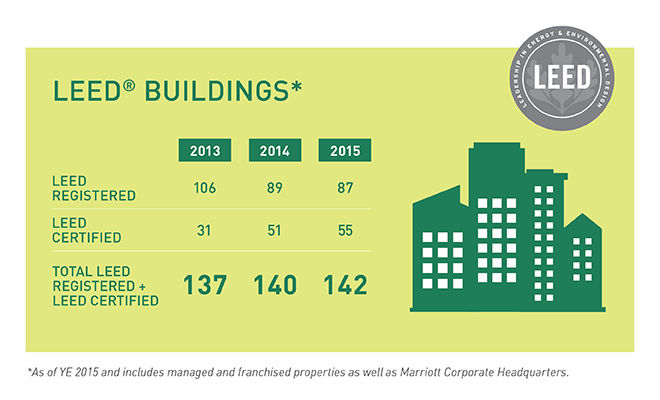
* Number of Marriott hotels that had obtained LEED certification as of 2015.
Tourism and Investment, Nilay Canbay Öztürk, July 2017