
Data Centers: An Indispensable Part of the Evolving Urban Infrastructure Needs in Smart Cities
Real Estate Turkey: Data center investments have become quite widespread. As Entegre Project Management, you have managed numerous data center projects. What needs are driving companies to make these types of investments?
Entegre Project Management: It is an inevitable reality that, with the widespread adoption of these technologies in the near future—both in our country and around the world—urban infrastructure will evolve into smart grids through ongoing revisions; all technological devices within the city will communicate with one another, bringing the concept of the smart city into our lives; and data centers will become increasingly widespread to store the growing volume of data. Data centers are facilities where computer and network hardware is densely concentrated in a single location for the purpose of collecting, storing, processing, and distributing massive amounts of data.
Accordingly, any business requires a data center for every type of data it generates or uses. In recent years, investments in data centers have generally been made by government agencies, educational institutions, telecommunications companies, financial institutions, healthcare organizations, and similar entities.
GMTR: How long do these projects typically take?
EPY: In the modular data centers we’ve been involved with as Entegre Project Management, the design phase has averaged 12–15 months, while the construction phase has averaged 15–20 months. Of course, this timeframe varies depending on the project’s size and certification level (TIER level).
GMTR: Could you elaborate a bit on the certification level? What kind of certification system is applied in data center projects?
EPY: Data center system rooms house very expensive server devices that consume a great deal of energy and generate significant heat. Organizations store highly valuable information here, and this data is constantly being processed. Since these electronic devices are extremely sensitive, data center system rooms must maintain constant temperature and humidity levels. The electrical and mechanical systems for a data center must be designed independently and must be fully redundant; electrical installations are designed according to NEC standards, mechanical (HVAC) systems according to ASHRAE standards, and fire protection systems according to NFPA standards.
The Telecommunucations Industry Association, published the TIA-942 Telecommunications Infrastructure Standard for Data Centers has classified data centers according to their level of advancement.
The process by which the Uptime Institute established the Tier standards emerged with the aim of addressing the question, “How should the most reliable data centers be designed?”
Tier 1 level: These are data centers serving small businesses. Computer systems, electrical systems, and mechanical systems have no redundancy. Generally, there is no provision for power outages lasting more than 10 minutes. It offers an estimated availability of 99.676%.
Tier 2 level: Includes partial redundancy in power and cooling systems. It can withstand a 24-hour power outage using a generator. It offers an estimated availability of 99.741%.
Tier 3: Includes a backup power grid, backup power and cooling systems, and backup service providers. It can withstand a 72-hour outage. It offers an estimated availability of 99.982%.
Tier 4: All Tier 3 criteria are met. Additionally, it can withstand a 96-hour outage. A staff team is on duty 24/7. Site selection is very strict, and high-security measures are in place.
Tier 3 and Tier 4 levels are preferred in data center designs and implementations in Turkey.
GMTR: What are the infrastructure requirements for a data center?
EPY: As can be understood from the certification definitions, the most important elements in data centers are redundancy, continuity, efficiency, and, in addition to these, security.
Redundancy and continuity are crucial not only for ensuring constant access to the systems (i.e., the data center being operational 24/7) but also for data security. To ensure redundancy and continuity, the following systems are installed in data centers:
- Dual-path power supply,
- One-to-one redundant automatic transfer switch transformer systems,
- One-to-one redundant diesel generators (synchronization panels),
- UPS systems (static and/or dynamic uninterruptible power supplies) to ensure continuous power to IT loads,
- Redundant power supply for the system room
- Redundant cooling systems
- Redundant fuel systems
- Redundant gas-based fire suppression systems
- Automation systems (BMS & PMS) to monitor and manage these systems
Redundancy at the Tier levels is shown more clearly in the table below.
| TIER | POWER | UPS | GENERATOR | COOLING |
|---|---|---|---|---|
| 1 | SINGLE | N | NONE | N |
| 2 | SINGLE | N+1 | N | N+1 |
| 3 | DUAL (ONE ACTIVE) | N+1 | N+1 | N+1 |
During the prolonged power outages that occurred on December 29–30, 2016, the data centers for which we managed the project as Entegre Project Management successfully weathered this period without being affected by the outages.
GMTR: How is efficiency achieved in data centers?
EPY: The highest operating cost in data centers stems from the climate control of the data center system rooms under appropriate conditions. Therefore, when selecting HVAC systems based on the climate conditions of the location where the data center will be established and the building’s architecture, it is advisable to choose devices and equipment from systems that are highly efficient, have low operating and maintenance costs, require few spare parts, and have a long service life.
The largest portion of energy consumption in data centers is attributed to cooling systems. Data centers utilize precision-controlled air conditioning units and, more recently, high-efficiency indirect evaporative (adiabatic) free-cooling units, which have become increasingly common. Both high-efficiency indirect evaporative (adiabatic) free-cooling units and precision-controlled air conditioning units are configured as N+1, N+2, or 2N, depending on TIER standards (Tier 1–Tier 2–Tier 3–Tier 4) and the investor’s requirements.
In data centers, the PUE (Power Usage Effectiveness) value is used as a measure of efficiency. This PUE value is an indicator of the data center’s energy efficiency, calculated by comparing the IT load in the data center with the total energy consumed by the infrastructure. IT managers can monitor the energy efficiency of system rooms by tracking changes in the PUE value.
PUE = Total Power Consumed / Power Delivered to IT Equipment
The energy consumed by IT equipment used for data processing in server rooms—such as servers, access devices, storage units, backup units, and KVM switches—constitutes the total IT load. In addition, significant energy consumption and losses occur in other equipment powering the data center. Losses in cooling and humidification equipment, UPS systems and batteries, cables and PDUs, lighting, and similar components increase total energy consumption.
Given the high cost of energy and its environmental impact, it is essential to reduce this value as much as possible. The PUE values table below shows the levels of PUE efficiency that have been achieved over the years as a result of advancements in cooling technology.
| PUE | DCiE | Efficiency Level |
|---|---|---|
| 3.0 | 33% | Quite Inefficient |
| 2.5 | 40% | Inefficient |
| 2.0 | 50% | Average |
| 1.5 | 67% | Efficient |
| 1.2 | 83% | Highly Efficient |
PUE = Power Usage Effectiveness
DCiE = Data Center Infrastructure Efficiency
As Entegre Project Management, we have successfully implemented system selections in the data centers we have managed in recent years, achieving a PUE value of approximately 1.2. Depending on advancements in IT technology R&D and cooling system technologies, this value is expected to decrease even further in the coming years.
In recent years, data center buildings have been constructed in modules, which are converted into data centers as needed. This allows investors to make data center investments for new modules only when necessary. Additionally, since each module operates with its own independent mechanical and electrical infrastructure, this provides a significant advantage.
GMTR: How are security requirements met in data centers?
EPY: Allowing an external authorized individual to work without the supervision of authorized personnel increases the error rate and compromises information security. Controlling and logging entries and exits is crucial for traceability when necessary.
We can summarize the systems established for physical security in data centers as follows:
- Access control systems
- System rooms accessed via retinal scan
- Fire detection and suppression systems
- CCTV systems
- Turnstile access systems
- Vehicle access systems at facility entrances
GMTR: As far as we know, data centers can accommodate additional functions. What are the reasons for this?
EPY: Data centers have certain support units. These include NOC (Network Operations Center) Rooms established to ensure these interventions are carried out effectively and safely in situations requiring control and intervention; the CCTV Room set up for security purposes; the BMS&PMS Room, which houses the main center of the automation system; the Fire Automation Room, which serves as the central hub for fire detection and alarm systems; and the Fuel System Room, which contains the fuel storage and fuel automation systems for supplying fuel to generators. Of course, in addition to these, there are also office spaces.
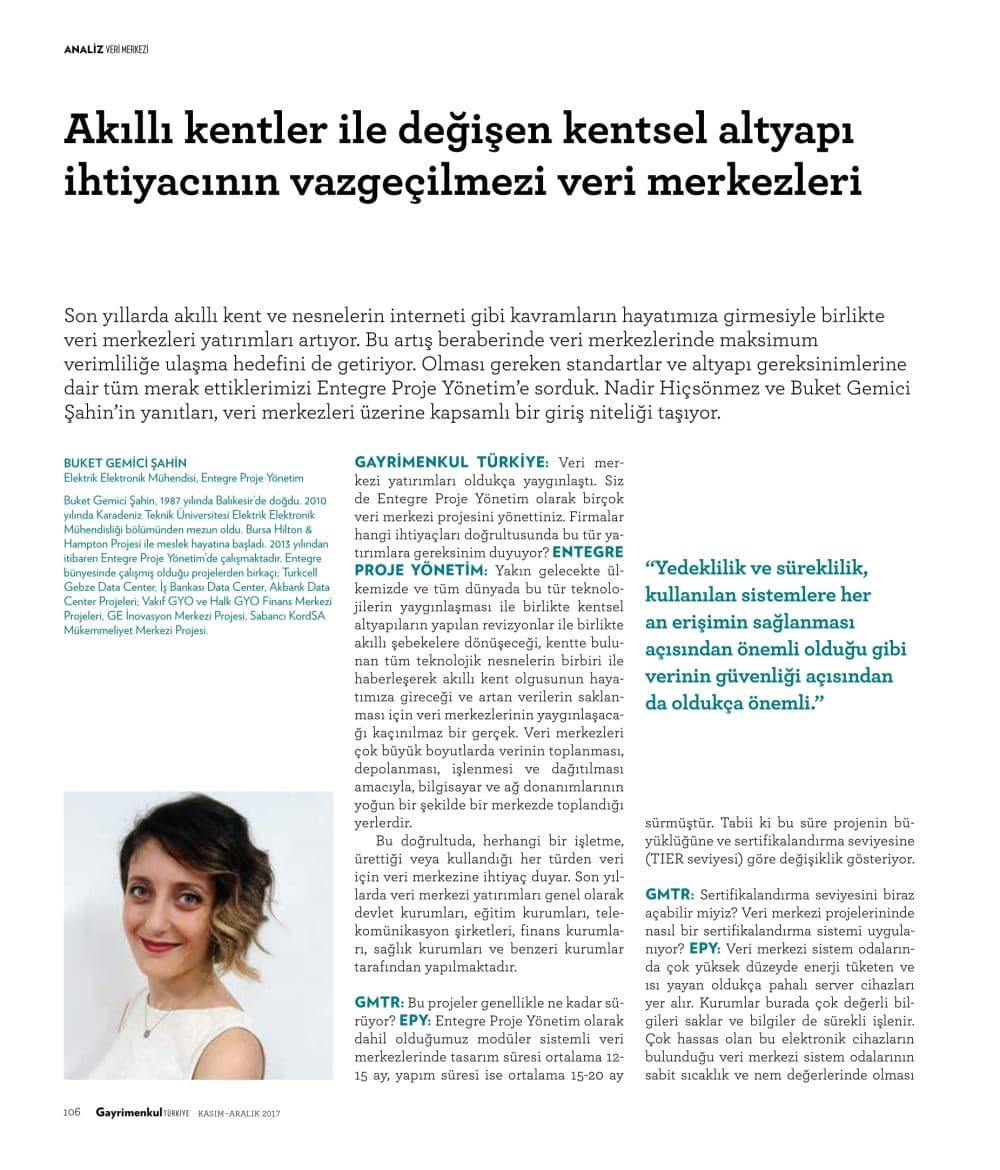
Real Estate Turkey, November/December 2017 — Nadir Hiçsönmez, Mechanical Engineer — Buket Gemici Şahin, Electrical and Electronics Engineer