How Should Transformation Take Place for More Effective Results?
As with everything else, transformation begins with imagination. First and foremost, people need to want to plan the places where they live, envision the future, and make an effort to achieve it.
When you search for “London 2050” on Google, you get at least 40 million results. The first headline relates to the “London Infrastructure Plan” prepared by the British government for 2050. Typing “New York 2050” yields 80 million results. However, typing “Istanbul 2050” yields only 549,000 results. The very first headline that appears is: “Where is 2050th Street?”
A city means people. A modern city is a place where people live, work, and study in harmony, sharing elements such as homes, parks, schools, roads, bridges, subways, and similar amenities. Therefore, for us to lead healthy lives, cities must also be healthy. By “healthy,” I mean, first and foremost, cities that meet people’s needs and are prepared for and resilient against potential risks and problems.
We all know the facts, but because we fail to fully confront them—choosing instead to ignore or postpone them—we are unable to be effective or achieve the results we aim for. A large portion of our land is at serious risk of earthquakes. The most tangible manifestation of this risk is the concern that buildings will collapse during an earthquake.
Following the 1999 Gölcük and Düzce earthquakes, the issue of earthquake risk began to be discussed more seriously. We can all imagine the potential consequences of an excessive stock of old and unsafe buildings, as well as haphazard and unregulated construction, in the event of a possible earthquake.
In parallel with the continuous advancement of earthquake engineering, countries are updating and enacting regulations to protect their citizens. The most recent earthquake regulation was updated in 2007. The current regulation does not cover buildings taller than 60 meters—that is, approximately 20 stories or higher. The revised code, which would include high-rise buildings, is currently under review by AFAD. The new code must be enacted as soon as possible.
Under the Urban Transformation Law enacted in 2012, the goal is to convert approximately 7 million of the roughly 20 million residential units in our country—those classified as “dilapidated”—into sound and safe buildings as soon as possible. To grasp the magnitude of these figures, we need roughly $500 billion in funding—excluding land costs and various other expenses—to construct these 7 million housing units.
This means that our first problem to be solved is financial RESOURCES.
Unfortunately, there are differences between projects designated as “high-risk areas” and individual initiatives. Demolishing an existing building and constructing a new one with more independent units is also referred to as “Urban Renewal.” At best, this should be called “Building Renovation.” Currently, the approach in Istanbul and our other cities unfortunately follows this model predominantly. The primary goal of Urban Renewal was to ensure that our citizens could live in safe buildings within a more livable environment, complete with green spaces and public amenities. Speaking specifically about Istanbul, however, the extent to which this has been achieved remains a mystery.
As seen on Bağdat Avenue, the ease with which building-based renewal projects can generate liquidity is the most significant factor attracting developers.
This means that our second problem to be solved is: building-based renovations that lack a holistic approach, even if financing is secured.
The legal framework is generally established without consulting all stakeholders and city residents, and without sufficient consultation with relevant and experienced industry partners. As a recent example, the New Zoning Regulation was republished with numerous amendments on September 30, 2017—just one day before it was set to take effect—in response to public backlash. Professional associations, civil society organizations, universities, and other relevant bodies are not included in the processes concerning urban transformation, which affects the entire community. Instead of adopting a holistic approach to solve these problems, palliative decisions and measures continue to be implemented.
The transformation of a “city” like Istanbul—whose very boundaries are difficult to define—cannot be considered separately from the country’s overall physical planning. It is impossible to claim that the concentration of 20% of the country’s population in a single metropolitan area resulted from a planning decision. We all know the fate of Istanbul’s 1:100,000-scale master plan.
In urban renewal projects based on areas designated as “high-risk,” proceeding without adequate infrastructure planning and investment—and without fully assessing the impacts on the surrounding areas—will likely lead to the same problems as building-based renovations, such as density issues, infrastructure challenges, and other related issues in the future. **As seen in the Fikirtepe example, proceeding without adequate planning leads to disputes over floor area ratios and maximum building heights, resulting in conflicts between contractors and residents that can lead to various grievances. Problems related to areas designated as high-risk zones, such as Fikirtepe, continue to this day. In the region, adequate infrastructure has not yet been completed. Those who have moved in are struggling even to get a phone line—imagine the other issues; it is unclear whether there will be enough natural gas and water.
The third problem we must address: the lack of long-term, holistic, and participatory PLANNING
Zoning issues create significant opportunities for “speculation.” The way to manage this situation for the benefit of all stakeholders is to ensure that decisions are made openly and transparently, and that review and planning efforts are not viewed as a waste of time.
Urban renewal must be addressed holistically, incorporating the views and suggestions of all stakeholders, and resolved as soon as possible following thorough planning.
To avoid facing even greater problems in the future and to ensure healthy, safe living environments, urban renewal must be carried out at the district or provincial level, rather than on a building-by-building or block-by-block basis.
How can we solve the problems in the urban renewal process? How can we achieve effective results that both support investors and protect consumers in the sector?
First and foremost, we must acknowledge that urban renewal is not the same as speculative development. Yet today, urban renewal is viewed as a national lottery, perceived as a ticket that increases building density and grants additional rights.
Today, property owners must stop focusing on what they receive and how to maximize it; solutions must prioritize the public interest over individual interests.
So, who will take us by the hand and guide us forward? The time has come for a higher authority—that is, the State—to step in and support the financial structure of this process. In a free-market system, this issue has been left too unregulated. Urban transformation must be managed under a single authority. An institution—such as the Ministry of Urban Planning, whose name is already aligned with the subject—should, of course, encompass provincial and district administrations; it must redesign cities, establish rules, collect and distribute property owners’ rights through a fair system, and serve as the primary point of contact for all issues and solutions. It must be equipped with legal regulations to accelerate the transformation.
While making these plans, this agency should be able to determine density levels and green spaces, as well as carry out the necessary work to minimize negative social impacts. A system operating in this manner will also correct public perception regarding urban renewal. To summarize:
- A central authority composed of competent staff acting in a holistic manner should be established, and this authority should be responsible for completing urban renewal within a specified timeframe.
- Operational rules must be transparent and accountable.
- Long-term planning should be conducted by soliciting input from all stakeholders and experts, and these plans should span at least 10, 20, or 50 years.
- Cities’ green spaces and social amenities should be brought up to world standards.
- This body should introduce new tools—including the provision of low-cost loans—for the large urban population unable to renovate their buildings with their own resources.
- For all our citizens living in earthquake-prone buildings, areas should be established as soon as possible—designed to be low-cost and financed over the long term, perhaps with land provided free of charge by the government—and constructed in a short timeframe; high-risk buildings must be demolished immediately.
- It must be ensured that any “windfall” resulting from urban transformation is used for the benefit of the entire society, not just the government and contractors
- The functions and attractions of each city must be defined. For example, to develop Istanbul as a center for trade, tourism, culture, and finance, planning should be aligned with this vision; an accelerated program could be implemented to relocate the manufacturing industry to other regions through incentives; and the population of megacities like Istanbul could be reduced to make them more livable.
In conclusion, I would like to emphasize that a comprehensive Urban Transformation must be implemented immediately. Otherwise, Urban Transformation will cause more suffering and inflict greater harm. And most importantly, we must have new living spaces and buildings that will ensure we do not lose a single citizen in the event of any potential earthquake.
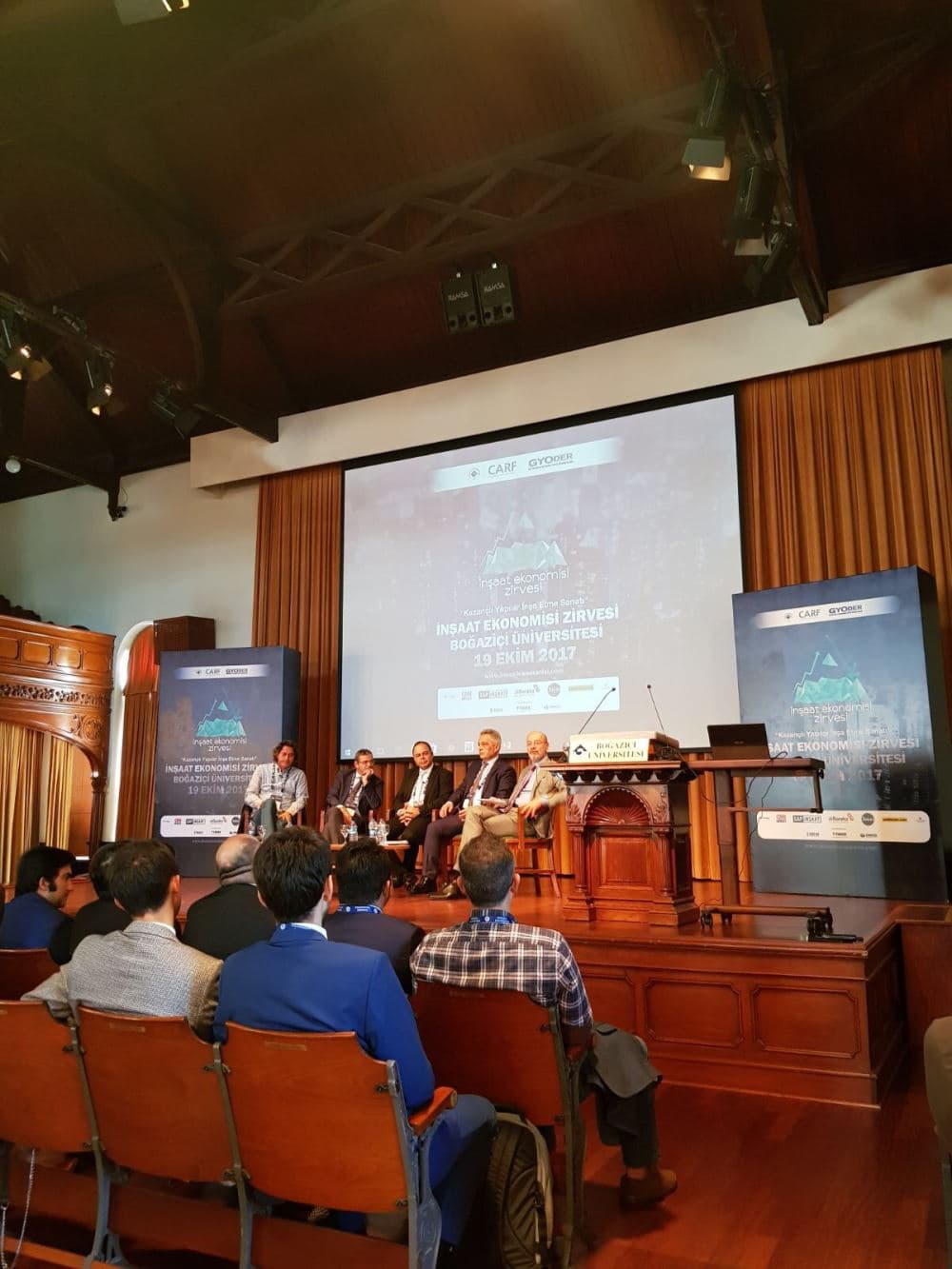
Kemal Okumuş, Speech at the Construction Economics Summit ’17, October 19, 2017